| Curious how your salary stacks up? Dive into our in-depth report: The Complete Attorney Compensation Report 2025-2026 - Definitive U.S. Legal Salary Guide. |
The legal profession is entering a period of heightened salary competitiveness. From BigLaw behemoths to solo practices, compensation dynamics are evolving fast — and understanding today’s benchmarks is vital for career planning, recruiting, or firm budgeting. Based on a detailed survey by BCG Attorney Search, covering all 50 states and multiple data sources, here’s a synthesized and navigable guide.

At a Glance
| Metric | Value / Trend |
|---|---|
| National Mean Attorney Salary | ~$176,470 |
| BigLaw vs. Small Firms Differential | ~340% premium |
| Highest State Mean | District of Columbia: ~$238,990 |
| Total U.S. Attorney Count | ~731,340 practicing attorneys |
These figures underscore a legal market marked by strong upward pressure — especially in major metros, specialized practices, and among large firm associates.
How the Numbers Were Compiled
Before relying on any benchmark, it’s crucial to grasp how the data was put together:
- Multiple Data Sources: The report aggregates information from the Bureau of Labor Statistics, NALP, American Lawyer, Major, Lindsey & Africa, Robert Half Legal, and other well-regarded sources.
- Cross-segmentation: Salaries are segmented by geography (all 50 states + DC), firm size, attorney experience levels, and practice area.
- Adjustments & Validation: Statistical methods, outlier removal, and cross-source validation were used to refine results.
- Caveats: These figures are estimates of base or median compensation; actual total pay may include bonuses, equity, benefits, and individual performance differentials.
Hence, the guide is best viewed as a benchmark baseline, rather than rigid salary prescriptions.
Regional & State Compensation Variance
- Top-tier states: DC ($238,990), California ($213,860), Delaware ($212,360), New York ($208,480), and Connecticut ($195,730).
- Lower-end states: Montana ($88,600), Mississippi ($93,380), Arkansas ($94,800).
- Regional trends:
- Northeast & West Coast dominate in raw dollars, especially NYC, Silicon Valley, and Washington, D.C.
- South & Midwest offer moderate compensation but often better cost-adjusted value.
- Secondary & Mountain markets are gaining ground, especially as remote work allows attorneys to reside in lower-cost areas while servicing high-paying clients.
In sum: location still matters a lot — but flexibility and remote work are leveling certain playing fields.
Firm Size & Attorney Level Dynamics
How big the firm is — and how far along you are in your career — drastically influence compensation:
By Firm Size
- Solo / small practices (1–10 attorneys): $45,000–$165,000 depending on experience.
- Small / regional firms: First-years $55,000–$95,000; partners $125,000–$225,000.
- Midsize (11–100 attorneys): First years $105,000–$145,000; partners $250,000–$450,000.
- Large firms / AmLaw 200 / BigLaw:
- Large: first-year $150,000–$190,000
- AmLaw 200: $180,000–$215,000
- BigLaw (1,000+ attorneys): base $225,000 + bonuses, and equity partners can earn $1.5M+
By Experience / Rank
- Junior associates (0–3 years):
- BigLaw: $225K–$260K
- Midsize: $105K–$145K
- Small: $55K–$95K
- Mid-level associates (4–6 years):
- BigLaw: $310K–$390K
- Midsize: $135K–$185K
- Small: $75K–$125K
- Senior associates (7+ years):
- BigLaw: $420K–$435K
- Large: $220K–$280K
- Midsize: $165K–$215K
- Small: $95K–$145K
- Partners & Counsel roles:
- Equity BigLaw partners: $1.5M – $3M+
- Non-equity partners: $350K – $750K
- Of Counsel / senior advisors: $200K – $450K
These progressions reflect both the steep climb in legal compensation and the high stakes at higher levels. For a deeper dive into how equity and non-equity partners are compensated across regions and firm sizes, see BCGSearch’s Law Firm Partner Compensation 2024-2025 analysis.
Practice Areas & Specialty Premiums
Not all legal work is priced equally. Some areas consistently command a premium:
- Top-paying fields:
- Antitrust & Competition: +25% over baseline
- Securities: +22%
- IP / Patent Litigation: +20%
- M&A / Corporate: +18%
- Tax: +15%
- Lower-paying / discount areas:
- Family Law: –5%
- Criminal Law: –10%
- Immigration: –15%
- Personal Injury: highly variable (often contingency-based)
Even among specialties, scale matters. For instance, an antitrust associate in BigLaw might earn $450K median, while at a midsize or small firm the numbers drop sharply.
Comparisons: In-House, Government & Small Practice

Legal careers beyond private practice tell different stories:
- In-house counsel / corporate legal roles:
- Median general counsel: ~$319,000
- Deputy GCs, senior attorneys, associate GCs: $232K–$468K depending on rank.
- Superior work-life balance and alignment with business strategy often offset some pay gaps.
- Government & public sector attorneys:
- Federal (GS-14/15): ~$140K–$191K
- State AGs, public defenders, prosecutors: ~$58K–$165K
- Benefits: stability, pensions, public service mission, loan forgiveness programs (in some cases).
- Solo / small practice attorneys:
- Experienced median ~ $125,000 (with wide variation).
- High reward possible for niche expertise or effective business development, but also greater risk and variability.
Trends, Projections & Strategic Recommendations
Salary & Growth Dynamics
- BigLaw first-year associate salaries climbed ~18.4% from 2020 to 2025.
- The national mean attorney salary rose ~12.8% in the same span.
- In-house roles saw ~15.2% growth.
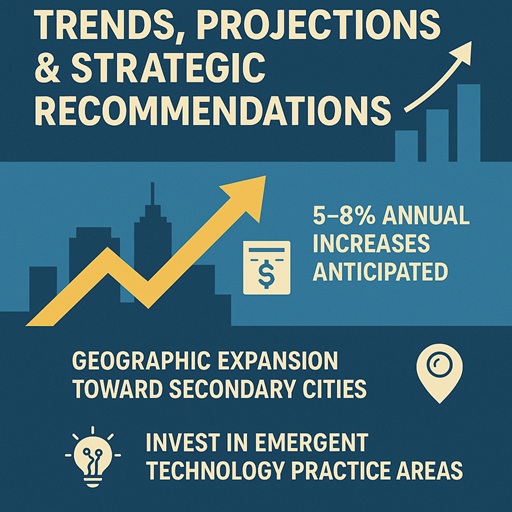
- 5–8% annual increases are anticipated for BigLaw and major markets.
- Geographic expansion toward secondary cities and regions is expected to continue. As for report on Navigating Legal Hiring and Compensation Trends in 2024 highlights, remote hiring models and hybrid workplaces are reshaping attorney recruitment and compensation strategies.
- Emergent technology practice areas (AI law, data privacy, cybersecurity) may soon command higher premiums.
- Remote work will further blur location-based boundaries and enable compensation arbitrage.
For Law Firms: Staying Competitive in 2025–2026
- Design retention packages that go beyond base salary — include bonuses, equity, flexible work, professional development.
- Explore geographic expansion or hybrid models to tap into new attorney talent pools.
- Invest in cutting-edge practice areas and training (e.g. AI, data privacy).
- Offer flexibility and remote work to retain talent, especially for mid-level associates.
- Focus on client relationships and differentiation, particularly in premium practice domains.
For Attorneys & Aspiring Lawyers
- Pursue specialized expertise in high-premium fields (e.g. securities, antitrust, IP) — the payoff may be substantial.
- Consider geographic arbitrage — working remotely from lower-cost areas while billing clients in major markets.
- Foster portable client relationships early — these generate real leverage in future transitions.
- Stay current on legal tech and AI tools — proficiency may become a differentiator.
- Don’t just look at base salary — evaluate total compensation (bonuses, equity, benefits, autonomy). Attorneys considering lateral moves should review BCGSearch’s Salary Realities in a Lateral Move for insights on weighing long-term growth and overall compensation packages.
Final Thoughts
The 2025–2026 legal compensation landscape is a competitive terrain shaped by geography, firm scale, specialization, and experience. BigLaw continues to define top-end benchmarks, but mid-size firms, in-house roles, and smaller practices all present opportunities — especially when combined with niche expertise or strategic flexibility.
For attorneys and firms alike, success in this decade hinges on adaptability: specializing in high-value areas, embracing remote flexibility, and aligning compensation strategies with market realities.
| Curious how your salary stacks up? Dive into our in-depth report: The Complete Attorney Compensation Report 2025-2026 - Definitive U.S. Legal Salary Guide. |