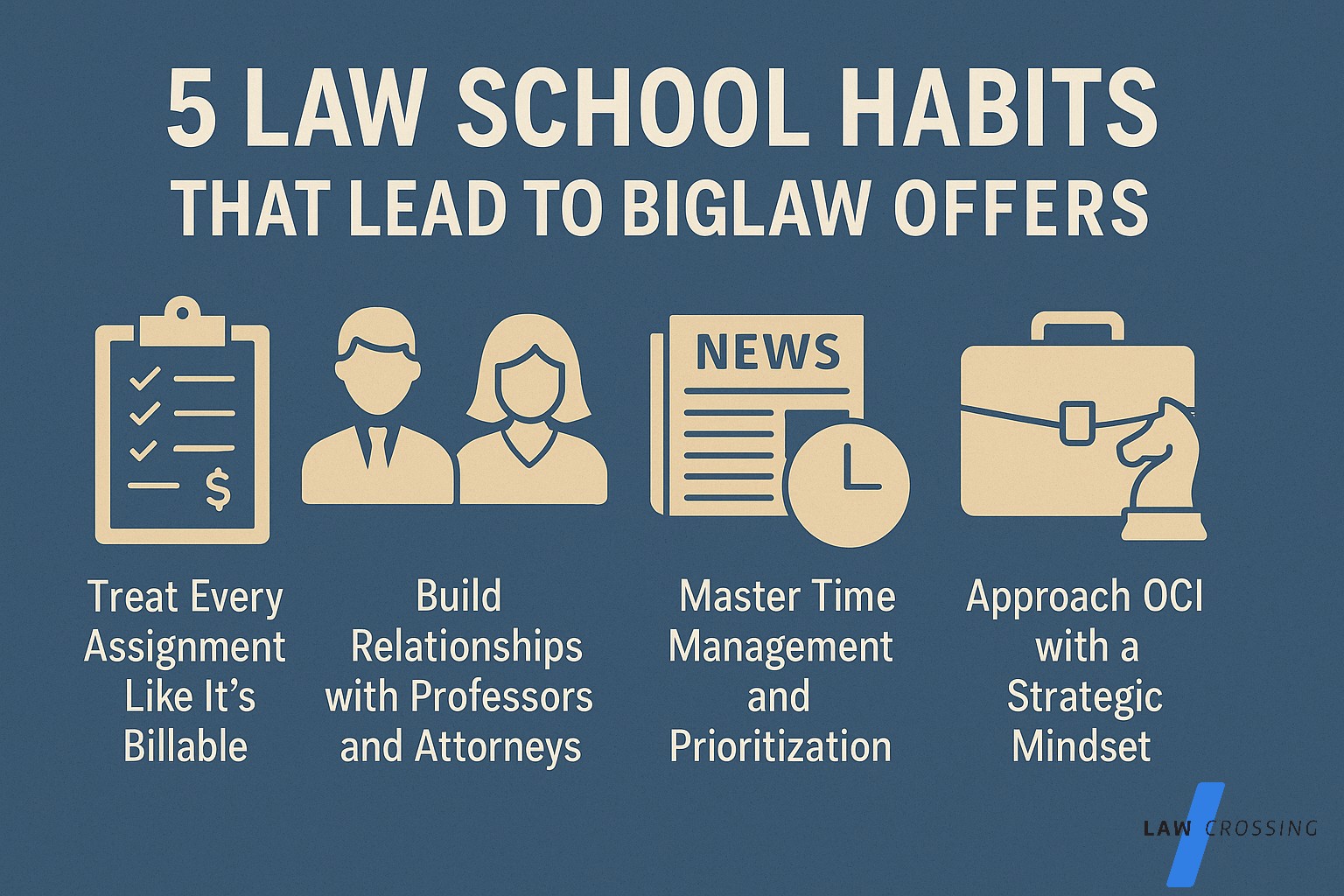
Securing a coveted BigLaw offer isn’t just about your GPA or law school ranking—it’s about developing the right habits early and consistently. Top law firms are looking for candidates who demonstrate more than just academic excellence. They want maturity, work ethic, and the ability to thrive in a high-pressure environment.
Here are five proven habits that help law students land BigLaw offers—and stand out during on-campus interviews (OCI), callbacks, and beyond.
1. Treat Every Assignment Like It’s Billable
In BigLaw, time is money—literally. Attorneys bill clients in six-minute increments, and every piece of work is expected to meet professional standards. Law students who get in the habit of treating their assignments like they’re on the clock will not only improve their academic performance but also signal to firms that they’re ready to handle real-world legal work.
This mindset shift means viewing even routine law school assignments—like a legal memo or case brief—as opportunities to demonstrate clarity, precision, and professionalism. It also means getting comfortable with deadlines, proofreading meticulously, and understanding how to balance efficiency with accuracy.
Why It Works:
- Prepares you for firm life: BigLaw associates don’t get unlimited time to revise or ask for extensions. Learning to produce polished work efficiently is essential.
- Elevates your work product: Professors, writing instructors, and journal editors notice when your submissions are organized, thoughtful, and free of careless errors.
- Strengthens your writing sample: Employers often ask for a writing sample during interviews. Your law school assignments may become the very documents that land you the job, so make them count.
How to Practice It:
- Meet every deadline without excuse
- Carefully edit your work before submitting
- Apply Bluebook citations properly, even on drafts
- Ask for feedback, and then implement it
- Treat class prep, clinic memos, and journal work like client work
2. Build Relationships with Professors and Attorneys
Strong relationships are one of the most underrated drivers of success in law school—and in landing BigLaw offers. Professors, adjunct faculty, guest lecturers, and practicing attorneys you meet through school-sponsored events are often more than just educators or speakers. They are mentors, connectors, and references who can directly impact your job prospects.
Building these relationships takes more than just attending class or listening passively during a panel. It requires genuine engagement, follow-up, and consistent communication. These connections can lead to research assistant roles, clerkship recommendations, interviews through alumni referrals, and insider advice on how to stand out in your job search.
- Professors and alumni often have hiring influence or connections with firms, judges, and in-house departments.
- A strong recommendation letter or phone call can move your application to the top of a hiring pile.
- Mentorship from attorneys provides real-world insights that go beyond what you’ll learn in class.
How to Practice It:
- Go to office hours regularly—not just to ask about grades, but to discuss topics you’re interested in or career advice.
- Follow up after meeting professionals—send a thoughtful email after a panel or networking event.
- Join law school organizations or journal boards where faculty advisors and alumni are active.
- Ask for informational interviews with attorneys working in your desired practice areas or firms.
Bonus Tip:
If you're working on a journal or clinic project, keep your professors or supervisors updated on your work and progress. These are natural ways to build rapport and demonstrate your reliability and legal skills.
Relationships built in law school often turn into career-defining opportunities. By taking initiative and building your network early, you position yourself as someone who’s not just academically strong but also trusted and remembered.
3. Stay Engaged with Legal Industry News and Trends
Law school is demanding, but students who consistently make time to follow legal news, firm developments, and broader industry trends gain a serious edge, especially when it comes to BigLaw interviews. Top firms want associates who are not only academically accomplished but also commercially aware and tuned in to what’s happening in the legal world.
Understanding current events in law—such as regulatory changes, major litigation, or firm mergers—helps you speak intelligently in interviews, draft more relevant writing samples, and demonstrate that you're already thinking like a practicing attorney.
Why It Works:
- Shows initiative and curiosity—qualities firms highly value in junior associates.
- Gives you strong interview talking points, especially in “Why this firm?” or “What areas of law interest you?” questions.
- Helps you align your interests with firms’ core practice areas or industry specialties.
- Reveals emerging opportunities in high-growth sectors like tech, healthcare, data privacy, and ESG.
How to Practice It:
- Set aside 10–15 minutes each day to scan reputable legal news sites like Law360, Above the Law, The American Lawyer, and Bloomberg Law.
- Subscribe to law firm newsletters to see how they market themselves, what cases they’re highlighting, and how they present their strengths.
- Follow legal professionals and firms on LinkedIn to stay current on trends and thought leadership.
- Join bar association student memberships, which often include legal updates and networking events.
- Listen to law-focused podcasts during commutes or workouts—great for staying informed passively.
Bonus Tip:
During interviews or networking conversations, casually referencing a recent case the firm handled—or a regulation impacting their clients—can instantly show you’ve done your homework and see the law in a broader, practical context.
Staying engaged with legal trends turns you from a student into a future lawyer in the eyes of employers. It signals that you’re serious about the profession—and already preparing to contribute on day one.
4. Master Time Management and Prioritization
BigLaw attorneys juggle demanding caseloads, tight deadlines, and constantly shifting priorities, and firms want to hire law students who show early signs of being able to manage that pressure effectively. Developing strong time management and prioritization habits in law school signals that you can handle the pace and complexity of BigLaw life.
Balancing casebooks, outlines, journals, externships, job applications, and social commitments requires more than a packed calendar. It requires strategic prioritization—knowing what deserves your full attention, what can be delegated or delayed, and how to meet competing deadlines without sacrificing quality.
Why It Works:
- Demonstrates your ability to meet deadlines reliably—a non-negotiable in legal practice.
- Reduces burnout and stress, helping you maintain performance throughout the semester.
- Frees up time to take on leadership roles, pro bono work, or internships—things that stand out to firms.
- Proves to employers you can handle the workload of a summer associate or junior associate without constant oversight.
How to Practice It:
- Use a structured calendar or planner (digital or paper) to schedule classes, assignments, meetings, and blocks of study time.
- Break large tasks into smaller goals, and set mini-deadlines to avoid last-minute scrambling.
- Prioritize high-impact activities like outline building, interview prep, and writing sample edits.
- Learn when to say no—not every networking event, meeting, or club is worth your time.
- Apply the “80/20 Rule”—focus on the 20% of tasks that will yield 80% of your results.
Bonus Tip:
During interviews, be prepared to discuss how you balanced competing responsibilities in law school. Employers want to hear real examples of how you managed a heavy workload under pressure.
By mastering time management and prioritization now, you're not just boosting your academic success—you’re showing BigLaw firms that you have the self-discipline, efficiency, and foresight needed to thrive in a high-stakes environment.
5. Approach OCI with a Strategic Mindset
The On-Campus Interview (OCI) process is the gateway to most BigLaw summer associate positions, and how you prepare can significantly influence your outcome. While some students approach OCI as a numbers game, blindly mass-bidding on firms without research or reflection, the most successful candidates treat it as a targeted strategy exercise.
A strategic approach to OCI involves understanding which firms align with your interests, tailoring your materials and interviews accordingly, and thoroughly preparing to communicate your strengths in a clear and compelling way. Firms are not just evaluating your résumé—they’re assessing how well you understand their work, culture, and expectations.
Why It Works:
- Improves your chances of getting callbacks and offers by showing you're informed and intentional.
- Helps you stand out from peers who give generic answers or appear disorganized.
- Increases the odds you’ll land at a firm that’s the right cultural and practice fit, which matters long term.
- Demonstrates maturity, focus, and initiative—traits firms highly value in potential associates.
How to Practice It:
- Research each firm in your OCI bid list thoroughly. Learn about their practice areas, client base, culture, and recent deals or cases.
- Tailor your interview responses to highlight how your interests and background align with the firm's specific strengths.
- Polish your résumé, cover letter, and writing sample months before OCI begins. Don’t wait until the last minute.
- Conduct mock interviews with career services or trusted mentors to refine your delivery.
- Track your applications, interviews, and follow-ups in a spreadsheet to stay organized and avoid missed opportunities.
- Prepare thoughtful questions for each firm to show you’re genuinely curious and engaged.
Bonus Tip:
The most effective candidates don’t just “interview well”—they connect. They show genuine enthusiasm for the firm, demonstrate they’ve done their homework, and ask insightful questions that reflect their long-term goals.
Approaching OCI with strategy, preparation, and self-awareness sets you apart as someone who not only wants a BigLaw job but understands what it takes to succeed in one.
| See Related Articles |
Final Thoughts: BigLaw Offers Start with Day-One Habits
BigLaw hiring may feel mysterious, but it’s largely built on observable traits: consistency, professionalism, curiosity, and judgment. By developing these five habits early in law school, you’ll position yourself as a high-performing candidate and stand out to firms long before interview season begins.