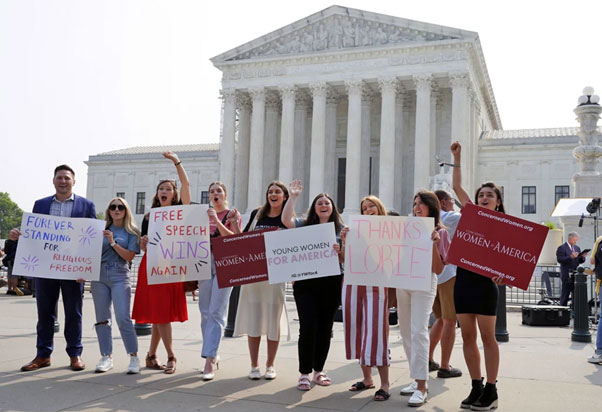
The U.S. Supreme Court's recent decision to allow an evangelical Christian web designer to deny services for same-sex weddings reflects a concerning prioritization of religious interests over the protections of LGBT individuals. With a 6-3 ruling, primarily driven by the court's conservative majority, the decision supported Lorie Smith, the owner of 303 Creative, a web design business near Denver. Smith sued Colorado's civil rights commission in 2016 out of fear of punishment for refusing to provide services for gay weddings. This refusal went against a state law that prohibits businesses open to the public from denying goods or services based on characteristics such as race, gender, sexual orientation, religion, and others.
The ruling invoked the First Amendment of the U.S. Constitution, which protects freedom of speech, to argue that Colorado cannot compel Smith to create content that contradicts her beliefs. While the case was presented to the court as a matter of free speech, it shares similarities with other recent conflicts between religiously motivated actions and civil rights laws.
Elizabeth Platt, the director of the Law, Rights, and Religion Project at Columbia Law School, highlights the significant expansion of rights for conservative religious communities, which has had a detrimental impact on equality, particularly for LGBTQ individuals. Colorado is among the 22 states in the U.S. that explicitly prohibit discrimination based on sexual orientation and gender identity in public accommodations.
The Alliance Defending Freedom has represented other prominent litigants, such as Colorado baker Jack Phillips, who refused to create a wedding cake for a gay couple based on his Christian beliefs. In the 2018 Masterpiece Cakeshop v. Colorado Civil Rights Commission, the court ruled 7-2 that the commission displayed unacceptable hostility toward religion when it found Phillips violated the state's anti-discrimination law. However, the court did not provide a definitive ruling on the circumstances in which individuals can seek exemptions from anti-discrimination laws on religious grounds. This ruling underscored the court's differing treatment of protections for LGBT individuals compared to competing conservative Christian interests, according to Platt.
Platt argues that the court handled Jack Phillips' claim of discrimination with significant deference and sensitivity while downplaying the discrimination faced by same-sex couples. This discrepancy reveals a troubling disparity in the court's perception of protections for LGBT individuals compared to the interests of conservative Christians.