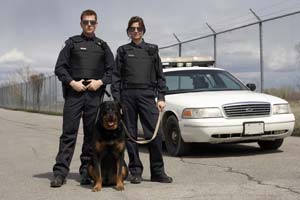
Writing for the majority Justice Antonin Scalia observed “A police officer not armed with a warrant may approach a home and knock, precisely because that is no more than any private citizen might do … But introducing a trained police dog to explore the area around the home in hopes of discovering incriminating evidence is something else … There is no customary invitation to do that.”
Scalia emphasized that when it came to interpreting the Fourth Amendment, “the home is first among equals.”
The decision by the U.S. Supreme Court taken on Tuesday upheld the 2011 ruling by the Florida Supreme Court in suppressing evidence uncovered by the use of a drug-sniffing dog not accompanied by a proper search warrant. That case involved one Joelis Jardine, accused of keeping drugs stashed in his home.
A public defender, Howard Blumberg who had argued for Jardine welcomed the decision of the U.S. Supreme Court on the matter. He said, “It’s a very important decision for all citizens, because it helps ensure their right of privacy in the places where they live.”
In the case of Jardine, the handler of the drug-sniffing dog Frank had led the dog to sniff outside the base of the front door of Jardine’s home following a tip that Jardine was growing marijuana inside his home. When the reactions of the dog confirmed that the smell of drugs was present inside the home, the police obtained a search warrant to go inside. Jardine was arrested after the police found more than 11 kilograms of marijuana inside his home.
In a concurring opinion, Justice Elena Kagan wrote, joined by Justice Ruth Bader Ginsburg and Justice Sonia Sotomayor that the search had violated reasonable expectation of privacy, and that a drug-sniffer dog “was not your neighbor’s pet.”
However, in dissent Justice Samuel Alito, joined by Chief Justice John Roberts, Justice Anthony Kennedy and Justice Stephen Breyer observed that dogs have been used by law-enforcement authorities for centuries and the use of a drug-sniffer dog did not constitute any trespass.
Alito noted in dissent, “A reasonable person understands that odors emanating from a house may be detected from locations that are open to the public …” and he/she “will not count on the strength of those odors remaining within the range that, while detectable by a dog, cannot be smelled by a human.”
In response, Scalia observed “the antiquity of the tools that they bring along is irrelevant,” mentioning that in 2001, the court had voided the use of thermal imaging technology to peer inside homes without a warrant from afar.