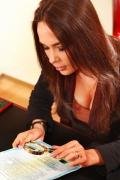
Ms. Gustin became a paralegal for love of the law. She became a fire investigator by chance—and she loves both.
In 1996, Ms. Gustin began working as a freelance paralegal for an expert witness, focusing on complex litigation involving fires and explosions. She was handling more and more cases and fact reviews for them, and it was noted that Ms. Gustin would make a good inspector. She jumped at the chance.
"I really enjoy the investigation field, and as I said before the paralegal skills, they just fall into line," she said. "You have dig to the bottom of the floor at times. I don't care about the dirt. I'm there to solve a puzzle. Believe me, you get dirty, honey, you do. I swear my coveralls could stand up by themselves a couple of times."
Ms. Gustin, who grew up in Harrisburg with seven siblings, started her career in the 1970s as a secretary and stenographer for the state of Pennsylvania. She worked for a state welfare fraud investigation unit, working her way up to various legal positions with the state for 23 years. She was eventually promoted to Agency Regulatory Review Coordinator.
She earned a Bachelor's Degree in Business from Penn State in 1986 and worked as a legal assistant and then became a state grant program manager, with responsibility for 14 nonprofit organizations and an $825,000 annual budget. That unit lost its funding, and Ms. Gustin decided it was time to move to the private sector.
Ms. Gustin, 50, returned to the legal field full time in 1996 when she started working freelance for UBA Fire Inc., which investigates the origins and causes of fires and explosions. UBA's clients include multi-national manufacturers, gas pipeline companies, gas distribution companies, public utilities, attorneys and insurance companies.
"I'm very strong in the product liability litigation area," she said. "A lot of our cases, cases that involve fire and explosions, many times involve a product or a service. What an origin and cause investigator does is they go out to a fire scene, and, based on your investigation, you need to pinpoint what your area of origin would be, that would be what location in the house or what location in the building the fire may have started."
She does not investigate arson fires—that's for the public sector, police and fire departments.
"I take the cases for the expert from start to finish. It's from when the incident happened until the time of trial. And maybe even sometimes during the trial, depending on what kind of information comes out of the trial."
Ms. Gustin builds her "Bible" of a case by reading all the documents involved in a case, doing a fact review, and, if she is investigating the physical fire scene herself, she writes an opinion on the fire.
Investigating a fire scene requires photographic skills and drafting skills too, because the investigator may have to draw a diagram of the scene.
Ms. Gustin, who often writes articles for "Facts and Findings" and has been active in various paralegal associations, said she was honored and surprised to be included in the upcoming book, "Lessons From the Top Paralegal Experts."
Ms. Gustin said fire investigation and paralegal work go hand in hand but that the fire investigation world can be difficult to break into. She was lucky in that she worked with investigators each day as their legal support and got a lot of on-the-job training. She also went back to school.
From January 2000 until May 2002, she completed numerous courses in fire science technology, along with completing more than 200 hours of professional seminars at her own expense. All the while she was still working with UBA Fire.
In January 2001, Ms. Gustin was sent on her first independent fire investigation. UBA periodically sent her out on inspections while she continued her paralegal work. To learn more, she often went to fire scenes with more experienced inspectors to observe them work.
In May 2000, Ms. Gustin also obtained her Certified Legal Assistant credential from the National Association of Legal Assistants. The year previous, she joined the National Fire Protection Association, where she is a member of the Research Committee. In 2001, she became a Certified Fire and Explosion Investigator through the National Association of Fire Investigators.
She did all that while running her own business. Ms. Gustin said working from home was hard at first because she couldn't stand the isolation. But now she values the lack of distractions when she's working on a case.
"The work is so exciting and fascinating," she said. "In terms of the legal field itself, boy it's changing so fast, paralegals have a full time job keeping up with all of that. With the advent of electronic filings and a lot of the other changes. It's a lot to keep up with but you must. It's worth it."
She urged paralegals interested in fire investigations to study. There are four-year degrees in fire science, or try to get an internship with an investigator.
"Anybody can do it but you have to really have a knack for investigation. You need a vast amount of education and experience. It won't happen overnight," she said. "It's five years into it and I'm still hoping, trying to get my name out there and trying to build a good reputation… My advice would be get your feet wet in the legal field. See if you like that first."
But she warns that fire scenes - particularly automotive fires can be hazardous. And it's important, she stressed, to maintain objectivity on a case, even when people die in the fire. Ms. Gustin said she always remains objective but is haunted by fires where children have been burned.
"I don't think I know any paralegal out there who has ever said 'oh these cases don't bother me'. There's always one that will haunt you. Because you're a human being," she said. "But you know our goal is to assist that supervising attorney in giving the best client representation possible."