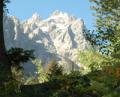
Kenya is best known for safaris to observe wildlife in many of its 59 parks and reserves. Slightly larger than Texas, the countryside is etched by ever-changing terrains and two towering mountains more than 17,000 feet tall: Mount Kenya in central Kenya and Mount Kilimanjaro barely across the border in Tanzania and clearly visible throughout the southwest. The Great Rift Valley, a geological phenomenon running like an ancient artery from Syria to Mozambique, divides Kenya from east to west. Landscapes shift shapes from the valley's wide plains into salt lakes, forests, deserts, highlands, shrubby bush and, most notably, wild animals and the Masai people, the most famous of Kenya's 42 tribes.
Kenya's most popular reserve is the Masai Mara in the southwest. The majestic Masai tribe calls this home. Literally meaning "spotted land of the Masai," it is an endless cascade of open plains. In the full months, golden grass, as tall as four feet, grows in every direction. Dirt roadways wind through some 320 square kilometers. As you ride through it, time seems to stop, or feels as if it hasn't yet begun. A cheetah turns to look at you between bites of a fallen gazelle. A herd of elephants, impervious to you, grazes mere yards away. Two giraffes wrap their long necks around one another. They are mating.
The acacia trees, like lone talismans, stand miles apart on the horizon like distant spots. And when winter comes by in late July (Kenya sits just below the equator), the stirrings of one of the world's natural wonders begin. Hundreds of thousands of tiny black dots speckle the golden grass. The great migration of wildebeest and zebra has begun. More than 3 million will come from Tanzania to eat and mate, then return again next year. A lion, as if sleepwalking, loped slowly past our van. This is their world, so breathtaking you wish that you could walk through it, as well.
There are only three hotels inside the reserve, and the Sarova Mara offers tented bungalows that feel nothing like a tent, with amenities like marble bath, hardwood floors and a writing desk. From here, vans leave to the reserve or Isoton Village, home of the local Masai tribe.
Daniel, one of the chief's 37 children, explained the Masai culture to visitors. Young warriors danced, brightly dressed women sang. Suddenly, a small child appeared, slipping her hand into a visitor's, beaming as she pulled her new friend across the dusty plain to meet her mother.
Kenyan friendliness extends to Tsavo, the country's largest reserve further south along the Tanzanian border. More than 20,000 square kilometers divide into Tsavo East and Tsavo West. The earth is pure red here, accounting for the famous "red elephants," so named because of their dusty ochre coating of dust.
Tsavo West is home to Finch Hattons. World renowned for its uniqueness and elegance, this award-winning tented lodge conjures the Kenyan experience as it was lived by its namesake, Denys Finch Hatton, who lived in Kenya in the early 20th century. Tsavo was Finch Hatton's hunting ground where he would lead safaris for other royals like the duke of Windsor - safaris complete with damask linens, fine crystal and Mozart. Lover to Baroness Karen Von Blixen, he was portrayed by Robert Redford in the film "Out of Africa."
In 1993, the lodge was completed, a cluster of 30 luxury tented structures raised on platforms around natural springs deep in the bush. Finch Hattons is not fenced. Hippos, crocodiles and other wildlife live in its springs. At night, escorts with bows and arrows accompany guests to and from the dining room, where they are served six-course dinners that easily compare to the best metropolitan dining. Finch Hattons has its own airstrip, a pool and an authentic experience that puts you straight into the Kenyan wild while pampering you with fine accoutrements and dining.
It is the dream fulfilled of Peter Frank, its creator and managing director. Frank, a German by birth, had worked in Kenya for Hilton Hotels for many years, loved the country and wanted to capture the magic of Kenya.
"I always had this desire to see the world, the unknown. For lots of Europeans, Africa was that magic land," Frank explained. "Here we are portraying an era probably gone out in the '40s and '50s. I can imagine the old days when dinner was the occasion of the day and people were talking to one another."
A six-hour drive (or short flight) further south uncovers more of Kenya's diversity along the Indian Ocean and in one of the oldest cities in Africa. If the Mara is yellow and Tsavo red, Mombasa is white. Its light stucco buildings and white sands recall its beginnings in the 15th century when it became an important port city that thrived with trade routes into Persia and the Far East. Built on an island, it is home to Kenya's largest Muslim population, and the Arabian influences appear in minarets that top its skyline and in its Old Town, where shuttered balconies of old homes and shops line narrow, winding streets around Fort Jesus, an enormous Portuguese fortress of coral blocks built in 1593.
Dining in Nairobi offers everything from game dishes at Carnivore to Swahili recipes for succulent fresh seafood at The Tamarind. Local crafts can be found at two Masai outdoor markets in Nairobi. Amani Ya Jou is a women's cooperative on the outskirts of Nairobi, where political refugee women sew beautiful fabric crafts and become self-sufficient. Kazuri Beads, next to the Dinesen Museum, specializes in handcrafted ceramic jewelry also made by local women.
Sir Colin M. Curtis has traveled to Kenya almost yearly since 1967. While at Finch Hattons, he talked of his love of the country: "If you were to take away all of the wildlife and the incredible people, which would be a tragedy indeed, you would still have natural grandeur unlike anywhere in the world."
You would also have a place where in Swahili there is no word for stranger.
IF YOU GO
A travel warning for Kenya is in effect from the U.S. State Department. The potential for crime in Nairobi is real and requires mindfulness as in any large city. Only malaria pills are required for entry, but avoiding fresh produce and local water is advised. Most international carriers serve Kenya through European connections in London and Amsterdam. Emirates, with a connection in Dubai, adds barely an hour to the total flight time, has much faster check-ins and excellent service. Air Kenya and Safari Link are local airlines that fly you to other cities and various reserves.
WHERE TO STAY
Rates are for a double room, high season, and can change:
Sarova Mara: $325, www.sarovahotels.com.
Finch Hattons: $400, www.finchhattons.com.
Mombasa Serena: $275, www.serenahotels.com.
Stanley Hotel: $130, www.sarovahotels.com.
Mary Martin Niepold is a freelance travel writer.
© Copley News Service