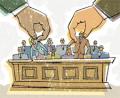
The upcoming trial of Kobe Bryant has once again placed at center stage the issue of televising real trials — in which the stakes are extraordinarily high. There are compelling arguments on both sides. Those who advocate televising trials point to the public's interest in seeing its courts at work. Just as debates in Congress — including the impeachment and trial of former President Clinton — are televised, so too should the workings of our judicial system be subject to public scrutiny. We should be able to see our judges in action and our legal system at work, warts and all. This is especially true in states where judges are elected by the voters.
The National Association of Criminal Defense Lawyers has argued that criminal trials should be televised only if the defendant agrees to it. They contend that the right to a public trial belongs primarily to the defendant, who has the greatest stake in the outcome of the case. The media responds by pointing to the public's right to be certain that the defendant is not abusing the system and that the prosecutor is not colluding with the defense. In the Bryant case the defense moved to close the courtroom to television cameras. The prosecution has taken no position on cameras, but agreed with the judge's decision to seal case documents. The complaining witness seems to be against television as well, since she has not disclosed her identity. This case, therefore, pits all of the participants against the media and the public. There is little doubt about the public's interest in the case, since Bryant is a world-famous basketball star, and the charges against him seem so inconsistent with his public persona.
But famous people are also entitled to fair trials. Striking a balance between the public's right to observe its courts and the defendant's right to a fair trial uninfluenced by public opinion is difficult. England has gone too far in the direction of insulating its courts from public scrutiny by banning contemporaneous print as well as television coverage. Perhaps in America we've gone too far in the other direction by conducting polls on how judges should decide pending cases. But these extremes shouldn't surprise anyone. England is far more elitist than the United States in many respects. The British appoint judges and prosecutors, while in most of our states we elect them. They seem to trust their legal system, while we are suspicious. They protect their judiciary with rules forbidding media coverage, while we cover every aspect of our high-visibility cases.
I generally favor televising trials, since I believe that the camera is more accurate than the often subjective accounts of reporters and the courthouse-steps spin of lawyers. But I also believe that in any case in which a criminal defendant opposes the televising of his trial, his rights must be balanced against those of the public.